In today’s competitive digital landscape, businesses cannot rely only on visibility, traffic, or brand awareness. They need marketing strategies that connect spending with measurable business outcomes.
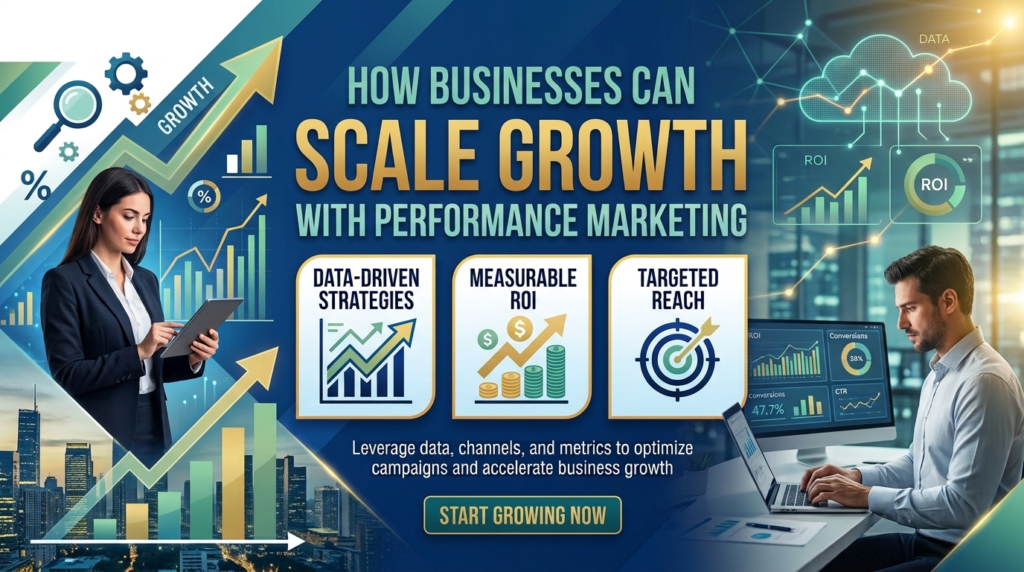
Performance marketing helps businesses build a more accountable growth strategy by focusing on measurable results such as qualified leads, sales, conversions, customer acquisition, and revenue.
Instead of simply asking, “How many people saw our campaign?”, businesses can ask, “How many customers did our marketing generate?”
For businesses looking to grow efficiently, performance marketing can turn digital advertising into a measurable growth engine.
What Is Performance Marketing?
Performance marketing is a data-driven approach where marketing campaigns are planned, measured, and optimized according to specific business objectives.
These objectives can include:
- Generating qualified leads
- Increasing online sales
- Improving conversion rates
- Reducing customer acquisition costs
- Increasing return on ad spend
- Growing website traffic
- Improving customer acquisition
Modern performance marketing can combine channels such as Google Ads, Meta Ads, SEO, content marketing, landing pages, analytics, and conversion optimization.
The goal is not simply to spend more on advertising. The goal is to make marketing spend work more efficiently.
1. Start With Clear Business Goals
Successful performance marketing begins with clearly defined goals.
A business should determine what it actually wants to achieve before launching campaigns. For example, an e-commerce company may focus on purchases, while a B2B company may prioritize qualified leads.
Clear goals make it easier to select the right campaigns, audiences, messaging, and KPIs.
Instead of measuring success through impressions alone, businesses can track metrics that directly support growth, such as:
- Cost per lead
- Cost per acquisition
- Conversion rate
- Revenue generated
- Return on ad spend
- Customer lifetime value
This creates a stronger connection between marketing activity and business performance.
2. Reach the Right Audience
Even a well-designed campaign can produce poor results if it reaches the wrong audience.
Performance marketing uses audience data, customer behavior, demographics, search intent, interests, and previous interactions to identify potential customers.
For example, Google Ads can capture users actively searching for a solution, while Meta Ads can help businesses reach specific audience segments based on interests and behaviors.
The objective is simple: put the right offer in front of people who are most likely to take action.
3. Build Conversion-Focused Landing Pages
Getting visitors to a website is only one part of the growth process.
If the landing page is confusing, slow, difficult to navigate, or lacks a clear call to action, advertising spend can be wasted.
A performance-focused landing page should:
- Clearly communicate the value proposition
- Address customer problems
- Build trust
- Provide relevant information
- Include strong calls to action
- Work effectively on mobile devices
- Make conversion easy
This is where marketing and web development need to work together.
WalstarTech focuses on conversion-oriented digital systems designed to generate qualified leads and support measurable business growth.
4. Use Data to Optimize Campaigns
Performance marketing is not a set-it-and-forget-it strategy.
Campaign data provides valuable insights into what is working and what needs improvement.
Businesses can analyze:
- Which campaigns generate conversions
- Which audiences perform best
- Which keywords attract high-intent visitors
- Which ads receive engagement
- Which landing pages convert
- Where potential customers leave the funnel
These insights allow marketers to continuously improve campaign performance instead of making decisions based only on assumptions.
5. Combine SEO With Paid Marketing
Paid advertising can generate immediate visibility, while SEO can support long-term organic growth.
Combining both strategies can create a stronger digital presence.
For example, paid campaigns can help businesses identify keywords and messaging that generate conversions. Those insights can then support SEO and content strategies.
Similarly, strong organic visibility can reduce dependence on paid traffic over time.
A combined approach can create multiple opportunities for customers to discover and interact with a business.
6. Focus on Conversion Rate Optimization
More traffic does not always mean more customers.
Conversion Rate Optimization (CRO) focuses on improving the percentage of website visitors who complete a desired action.
Small improvements to:
- Headlines
- Calls to action
- Forms
- Page layouts
- Offers
- Trust signals
- Website navigation
can influence campaign performance.
This means businesses can potentially generate more results from their existing traffic without simply increasing advertising budgets.
7. Scale What Works
One of the biggest advantages of performance marketing is the ability to identify successful campaigns and scale them strategically.
Suppose one campaign consistently generates qualified leads at an acceptable acquisition cost. Instead of increasing budgets across every campaign, businesses can gradually allocate more resources toward the campaigns, audiences, creatives, and channels producing stronger results.
This creates a data-driven scaling process.
The objective is not simply:
Spend More → Get More Traffic
It is:
Test → Measure → Optimize → Scale
8. Use AI and Automation to Improve Efficiency
AI is increasingly becoming part of modern digital marketing workflows, from campaign analysis and content creation to automation and customer engagement.
Businesses can use AI-powered systems to support:
- Lead qualification
- Customer communication
- Data analysis
- Marketing automation
- Personalized experiences
- Reporting
- Workflow automation
When combined with performance marketing, automation can help businesses reduce repetitive tasks while allowing teams to focus more on strategy and growth.
WalstarTech positions AI, automation, marketing, and modern digital systems as part of its broader approach to helping businesses scale.
9. Track the Complete Customer Journey
A click or lead does not necessarily mean business success.
Businesses should understand what happens after a prospect interacts with an advertisement.
The customer journey may look like:
Ad → Landing Page → Lead → Sales Follow-Up → Customer → Repeat Purchase
Tracking this journey helps businesses identify where opportunities are being lost.
For example, a campaign may generate many leads but few customers. In that situation, the problem may not be the advertising campaign. It could be lead quality, sales follow-up, pricing, or the conversion process.
Performance marketing becomes much more valuable when marketing and sales data are connected.
10. Make Marketing a Continuous Growth System
The strongest performance marketing strategies are built around continuous improvement.
Markets change. Customer behavior changes. Competitors change. Advertising platforms change.
Therefore, businesses need to continually:
Test → Analyze → Improve → Scale
This approach transforms marketing from a one-time campaign into an ongoing growth system.
Why Performance Marketing Matters for Business Growth
Performance marketing gives businesses greater visibility into how marketing investments contribute to growth.
Instead of relying only on traditional marketing metrics, businesses can connect campaigns with measurable outcomes.
When combined with SEO, paid advertising, conversion optimization, analytics, AI, and automation, performance marketing can create a more scalable digital growth strategy.
WalstarTech provides digital marketing solutions including SEO, Local SEO, Google Ads, Meta Ads, content marketing, lead generation, and conversion optimization, supporting businesses that want to build measurable growth systems.
Final Thoughts
Scaling a business does not always require dramatically increasing the marketing budget. It requires understanding where the budget produces the strongest results and continuously improving those opportunities.
Performance marketing provides the framework to test strategies, measure outcomes, optimize campaigns, and scale successful channels.
For businesses ready to move beyond vanity metrics and build a more measurable digital growth strategy, performance marketing can become a powerful engine for sustainable growth.
Ready to turn your digital marketing into a growth system? Explore WalstarTech’s performance-focused digital marketing solutions and start building a strategy designed around measurable results.
Frequently Asked Questions (FAQs)
1. What is performance marketing?
Performance marketing is a measurable digital marketing approach focused on outcomes such as leads, sales, conversions, and revenue.
2. How does performance marketing help businesses scale?
It helps businesses identify successful campaigns, optimize marketing spend, and gradually scale strategies that generate stronger results.
3. Is performance marketing suitable for small businesses?
Yes. Small businesses can use performance marketing to target specific audiences and control budgets while measuring campaign performance.
4. Which channels are used in performance marketing?
Common channels include Google Ads, Meta Ads, SEO, content marketing, landing pages, remarketing, and conversion optimization.
5. How long does performance marketing take to produce results?
Results vary by industry, audience, budget, offer, and campaign setup. Continuous testing and optimization are important for improving performance over time.
Grow Your Texas Business With WalstarTech
Ready to turn your digital marketing into measurable business growth? WalstarTech can help you build a performance-driven strategy focused on visibility, leads, conversions, and long-term growth.
Get in touch with WalstarTech today and start growing your Texas business with a results-driven digital marketing strategy.