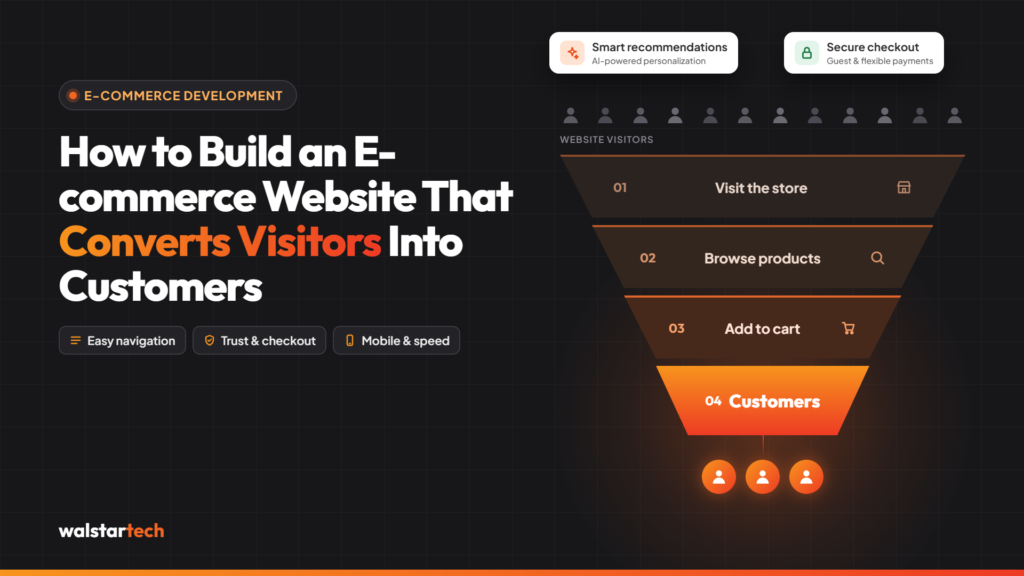
Building an e-commerce website is about more than putting products online. A successful online store needs to attract the right audience, build trust, provide a smooth shopping experience, and guide visitors toward completing a purchase.
With growing competition in the digital marketplace, businesses need an e-commerce website that is fast, mobile-friendly, secure, easy to navigate, and designed for conversions.
Here are 10 essential strategies for building an e-commerce website that turns visitors into customers.
1. Understand Your Target Audience
Before designing your e-commerce website, understand who your customers are and what they expect from your online store.
Research their:
- Buying behavior
- Preferences
- Pain points
- Budget
- Device usage
- Payment preferences
- Product expectations
Understanding your audience helps you create a website experience that feels relevant and makes it easier for visitors to find products they actually need.
2. Create Simple and User-Friendly Navigation
Customers should be able to find products quickly without navigating through complicated menus.
Organize your website using clear categories and subcategories. Include a powerful search function, filters, sorting options, and breadcrumbs where appropriate.
A simple structure could be:
Home → Category → Subcategory → Product → Cart → Checkout
For stores with large product catalogs, advanced search and filtering can significantly improve product discovery and help customers reach the right products faster.
3. Create Product Pages That Sell
Your product pages are among the most important elements of your e-commerce website.
Customers need enough information to make confident purchasing decisions.
A strong product page should include:
- High-quality product images
- Multiple product views
- Clear product titles
- Detailed descriptions
- Pricing
- Product specifications
- Available sizes or variations
- Stock availability
- Shipping information
- Return policies
- Customer reviews
- Clear Add to Cart and Buy Now buttons
Use product images and videos strategically to demonstrate how products look and work. The more uncertainty you remove, the more comfortable customers may feel about purchasing.
4. Build Trust and Simplify Checkout
Customers need to trust your business before providing personal or payment information.
Build credibility by displaying:
- Customer reviews
- Star ratings
- Testimonials
- Secure payment options
- SSL/HTTPS
- Clear return policies
- Shipping information
- Contact details
Your checkout process should also be as simple as possible.
Consider offering:
- Guest checkout
- Multiple payment methods
- Fewer form fields
- Clear shipping charges
- Mobile-friendly checkout
- Easy-to-understand order summaries
A complicated checkout experience can cause customers to abandon their carts before completing their purchases.
5. Make Your Website Fast and Mobile-Friendly
A modern e-commerce website needs to perform well across smartphones, tablets, and desktops.
Your website should provide:
- Responsive design
- Fast-loading pages
- Mobile-friendly navigation
- Easy-to-use buttons
- Optimized images
- Simple checkout forms
- Fast product search
Website performance also matters. Compress images, optimize website code, use caching, and choose reliable hosting to improve loading times.
A faster website creates a better shopping experience and can help keep customers engaged.
6. Use AI and Personalization
AI is changing how businesses interact with online shoppers.
E-commerce businesses can use AI to provide:
- Personalized product recommendations
- Smart product search
- AI-powered chatbots
- Frequently bought together suggestions
- Recently viewed products
- Automated customer support
- Personalized shopping experiences
Instead of presenting the same experience to every visitor, AI can help businesses deliver more relevant products and information based on customer behavior.
For businesses looking to introduce AI into their e-commerce strategy, WalstarTech can help integrate modern digital and AI-powered solutions into their online operations.
7. Optimize Your E-commerce Website for SEO
A well-designed website needs visibility to attract potential customers.
E-commerce SEO should cover important elements such as:
- Product titles
- Category pages
- Meta titles
- Meta descriptions
- Product descriptions
- URLs
- Image alt text
- Internal linking
- Structured data
- Website architecture
You can also publish useful content based on questions your potential customers search for.
For example, a footwear store could create content such as:
“How to Choose the Right Running Shoes for Beginners”
This type of content can attract users who are researching products before making a purchase.
8. Use Strong Calls-to-Action
Your visitors should always understand what action they can take next.
Effective e-commerce CTAs include:
Add to Cart
Buy Now
Shop Now
View Collection
Get Started
Place CTAs prominently on product pages and other important areas of your website.
A clear call-to-action reduces confusion and guides customers through the purchasing journey.
9. Track Performance and Continuously Optimize
Launching an e-commerce website is not the end of the process.
Businesses should regularly analyze website performance and customer behavior.
Track metrics such as:
- Conversion rate
- Add-to-cart rate
- Cart abandonment rate
- Average order value
- Product-page performance
- Checkout completion rate
- Traffic sources
- Mobile conversions
Use this data to identify areas that need improvement.
You can also perform A/B testing on elements such as product images, headlines, CTAs, layouts, and offers to determine what works best for your audience.
10. Work With the Right E-commerce Development Partner
Creating a high-performing e-commerce website requires expertise across multiple areas.
A successful online store may require:
E-commerce Development + UX Design + SEO + Performance Optimization + Security + AI + Digital Marketing
Working with an experienced technology partner can help businesses bring these elements together into one cohesive strategy.
WalstarTech helps businesses develop modern digital solutions with a focus on web development, UX, AI and automation, digital marketing, cybersecurity, and ongoing website support.
By combining technology with customer-focused design and digital strategy, businesses can create e-commerce websites that are built not only to attract visitors but also to encourage conversions and support long-term growth.
Final Thoughts
A successful e-commerce website should do more than showcase products. It should create a smooth journey from the moment a visitor lands on the website to the moment they complete their purchase.
By focusing on user-friendly navigation, persuasive product pages, trust, simple checkout, mobile optimization, AI personalization, SEO, strong CTAs, and continuous optimization, businesses can create an online store designed for better conversions.
Whether you are launching a new online store or improving an existing e-commerce platform, investing in the right technology and user experience can turn your website into a powerful sales channel.
Frequently Asked Questions (FAQs)
1. What makes an e-commerce website convert visitors into customers?
A conversion-focused e-commerce website combines easy navigation, compelling product pages, fast performance, mobile responsiveness, trust signals, secure payments, and a simple checkout process.
2. Why is mobile optimization important for e-commerce websites?
Mobile optimization ensures customers can easily browse products, compare options, and complete purchases on smartphones and tablets. A responsive mobile experience can help improve engagement and conversions.
3. How can I reduce shopping cart abandonment?
Simplify the checkout process, offer guest checkout, provide multiple payment methods, display shipping costs clearly, and avoid unnecessary form fields to make purchasing easier.
4. How can AI improve an e-commerce website?
AI can enhance e-commerce through personalized product recommendations, smart search, AI chatbots, automated customer support, and behavior-based shopping experiences.
5. How can WalstarTech help build an e-commerce website?
WalstarTech can help businesses develop conversion-focused e-commerce websites with web development, UX design, AI and automation, SEO, digital marketing, cybersecurity, and ongoing support.
Ready to build an e-commerce website designed for growth?
Partner with WalstarTech to create a modern, user-friendly, secure, and conversion-focused e-commerce experience for your business.