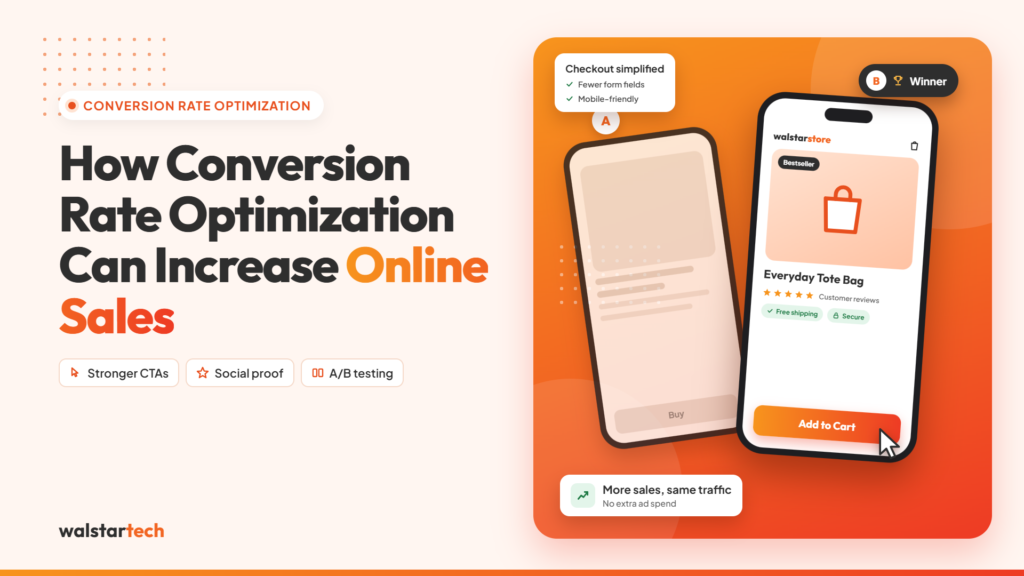
Getting more visitors to your website is important, but traffic alone does not guarantee more sales. If visitors leave your website without making a purchase, submitting an inquiry, or contacting your business, your marketing investment may not deliver the results you expect.
This is where Conversion Rate Optimization (CRO) can make a significant difference.
Conversion Rate Optimization is the process of improving your website, landing pages, content, and user journey to encourage more visitors to complete valuable actions. Instead of focusing only on attracting more traffic, CRO helps you get more value from the visitors you already have.
For businesses looking to increase online sales, improve lead generation, and maximize marketing ROI, CRO should be an important part of their digital strategy.
What Is Conversion Rate Optimization?
Conversion Rate Optimization is a data-driven approach to improving the percentage of website visitors who complete a desired action.
A conversion could be:
- Making an online purchase
- Submitting a contact form
- Requesting a quote
- Booking a consultation
- Signing up for a newsletter
- Downloading a resource
- Calling your business
- Creating an account
For example, if 1,000 people visit your website and 30 make a purchase, your conversion rate is 3%.
CRO focuses on identifying why other visitors are not converting and making improvements that can encourage more of them to take action.
Why CRO Matters for Online Sales
Many businesses assume that increasing traffic is the only way to increase revenue. While attracting qualified visitors is important, improving your conversion rate can often help you generate more sales without proportionally increasing your advertising budget.
Consider this example:
If your website receives 10,000 visitors every month and converts 2% of them, you generate 200 conversions.
If CRO improvements increase the conversion rate to 3%, the same traffic could generate 300 conversions.
That means 100 additional conversions from the same amount of traffic.
This is why CRO can complement SEO, paid advertising, social media marketing, and other customer acquisition strategies.
1. Improve Website User Experience
A confusing or difficult website can prevent visitors from becoming customers.
Users should be able to quickly understand:
- What your business offers
- How your product or service solves their problem
- Why they should choose you
- How much it costs or how to request pricing
- What action they should take next
Clear navigation, readable content, mobile responsiveness, intuitive layouts, and fast-loading pages can create a smoother customer journey.
A better user experience reduces friction and makes it easier for visitors to move from interest to action.
2. Create Stronger Calls to Action
A call to action (CTA) tells visitors what to do next.
Weak CTAs such as “Submit” or “Click Here” may not communicate enough value.
Instead, businesses can use action-oriented CTAs that clearly explain the next step, such as:
- Get Your Free Consultation
- Request a Free Quote
- Start Your Project
- Shop Now
- Book a Demo
- Get Started Today
The CTA should be visible, relevant to the page, and consistent with the visitor’s intent.
3. Build Trust With Social Proof
Customers are more likely to purchase when they trust a business.
CRO strategies can incorporate trust-building elements such as:
- Customer reviews
- Testimonials
- Case studies
- Client logos
- Industry certifications
- Awards
- Security badges
- Product ratings
- Results and success stories
For service-based businesses, testimonials and case studies can help potential customers understand the quality and results they can expect.
4. Simplify Forms and Checkout Processes
Long or complicated forms can create unnecessary friction.
If visitors need to provide too much information before requesting a quote or contacting your business, they may abandon the process.
Businesses can improve conversions by:
- Removing unnecessary fields
- Using clear field labels
- Providing helpful error messages
- Making forms mobile-friendly
- Explaining what happens after submission
- Offering multiple contact options
For ecommerce businesses, the checkout process is particularly important. Reducing unnecessary steps and making payment options clear can help create a smoother purchasing experience.
5. Optimize Landing Pages
Landing pages play an important role in paid advertising and lead-generation campaigns.
A strong landing page should have a clear connection between the advertisement and the page content.
For example, if an advertisement promotes “AI Automation Services,” the landing page should immediately explain the AI automation solution rather than directing users to a generic homepage.
An effective landing page typically includes:
- A clear headline
- A compelling value proposition
- Relevant benefits
- Supporting visuals
- Social proof
- A strong CTA
- Answers to common questions
- Minimal distractions
This creates a focused experience designed around a specific conversion goal.
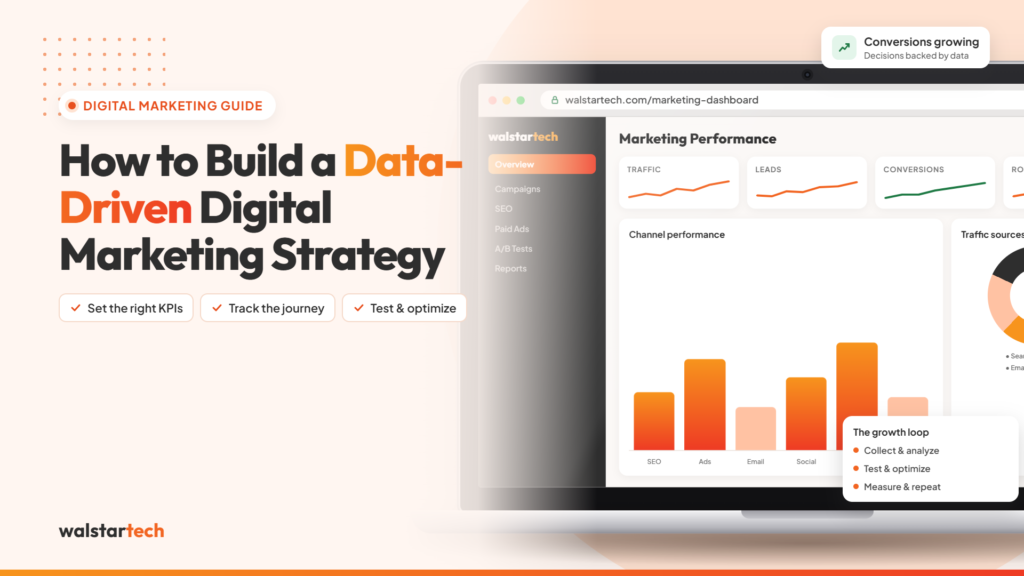
6. Use Data to Understand Visitor Behavior
CRO should not rely entirely on assumptions.
Businesses can use analytics data to understand how visitors interact with their websites, including which pages receive traffic, where users leave, and which actions lead to conversions.
Google Analytics allows businesses to measure important user actions and evaluate marketing performance across channels.
Tracking meaningful conversion events can help businesses identify opportunities for improvement and make more informed marketing decisions.
7. Test Different Website Elements
What works for one audience may not work for another.
A/B testing allows businesses to compare different versions of a webpage or element to determine which performs better.
Businesses can test:
- Headlines
- CTA wording
- Button placement
- Images
- Page layouts
- Form lengths
- Pricing presentation
- Product descriptions
- Testimonials
- Offers
The goal is not simply to make a page look different. The goal is to use testing and performance data to make better decisions.
Google has also highlighted a structured approach to conversion optimization: identify weak points, prioritize high-impact tests, and continuously test improvements.
8. Make Your Website Mobile-Friendly
A significant portion of online activity takes place on mobile devices.
If your website is difficult to navigate on a smartphone, visitors may leave before completing a purchase or inquiry.
A conversion-focused mobile experience should include:
- Responsive design
- Easy-to-read text
- Mobile-friendly forms
- Easy-to-tap buttons
- Simple navigation
- Fast-loading pages
- Streamlined checkout
Mobile optimization should not be treated as an optional feature. It should be part of the overall website experience.
How Walstar Tech Can Help
At Walstar Tech, we focus on building secure, scalable, and conversion-focused digital solutions for businesses across global markets. Our approach combines technology, user experience, digital marketing, analytics, and AI-driven solutions to help businesses build stronger digital growth systems.
From website development and digital marketing to AI-powered solutions, CRM, ERP, and automation, the right technology can help businesses create more efficient customer journeys and improve measurable business outcomes.
Our ERP and CRM solutions can also support sales automation, lead acceleration, conversion analytics, audience targeting, and integration with marketing platforms.
Final Thoughts
Increasing website traffic is only one part of online growth. The bigger opportunity may be converting more of the visitors you already have.
By improving user experience, strengthening calls to action, simplifying forms and checkout, building trust, optimizing landing pages, analyzing customer behavior, and continuously testing improvements, businesses can create websites that are designed not just to attract visitors but to generate results.
Conversion Rate Optimization is an ongoing process, not a one-time website update. By continuously measuring, testing, and improving the customer journey, businesses can create more opportunities for sales and long-term growth.
Frequently Asked Questions (FAQs)
1. What is Conversion Rate Optimization (CRO)?
Conversion Rate Optimization (CRO) is the process of improving a website and customer journey to increase the percentage of visitors who complete desired actions, such as purchases, inquiries, or form submissions.
2. How can CRO increase online sales?
Mobile optimization ensures customers can easily browse products, compare options, and complete purchases on smartphones and tablets. A responsive mobile experience can help improve engagement and conversions.
3. How long does it take to see CRO results?
The timeline depends on website traffic, conversion goals, existing performance, and the changes being tested. Some improvements may show results quickly, while ongoing testing can deliver stronger insights over time.
4. What website elements should be optimized for better conversions?
Key areas include headlines, CTAs, landing pages, navigation, page speed, forms, product pages, checkout processes, mobile experience, testimonials, and trust signals.
5. Can Walstar Tech help improve website conversions?
Yes. Walstar Tech provides conversion-focused web design, digital marketing, SEO, UX, and technology solutions designed to improve user experience, engagement, lead generation, and business growth.
Ready to Turn More Website Visitors Into Customers?
Walstar Tech can help you build a conversion-focused digital experience designed around your business goals.
Get in touch with Walstar Tech today and start optimizing your digital growth.