Digital marketing is no longer about guessing what customers want. Businesses can now use data to understand customer behavior, measure campaign performance, identify opportunities, and make smarter marketing decisions.
A data-driven digital marketing strategy uses customer insights, website analytics, advertising data, SEO performance, and conversion information to guide marketing activities. Instead of relying only on assumptions, businesses can use measurable information to determine what works and where improvements are needed.
For businesses competing in today’s digital environment, building a data-driven approach can improve marketing efficiency, increase qualified leads, and support sustainable business growth.
What Is a Data-Driven Digital Marketing Strategy?
Data gives businesses a clearer understanding of their marketing performance. Instead of simply measuring traffic or impressions, marketers can connect activities with business outcomes.
A strong data-driven marketing strategy can help businesses:
- Understand their target audience
- Identify high-performing marketing channels
- Improve SEO performance
- Optimize advertising campaigns
- Increase website conversions
- Reduce wasted marketing spend
- Improve customer experiences
- Generate more qualified leads
- Measure marketing ROI
The goal is not to collect as much data as possible. The goal is to collect useful data that supports better decisions.
How to Build a Data-Driven Digital Marketing Strategy
1. Define Clear Marketing Goals
Start by identifying what your business wants to achieve.
Your goals could include increasing website traffic, generating leads, improving online sales, increasing brand awareness, or reducing customer acquisition costs.
Make your goals measurable. For example, instead of saying “increase leads,” define a specific target such as increasing qualified leads by 25% over a particular period.
Clear goals make it easier to determine which metrics matter.
2. Identify Your Target Audience
Data can help you understand who your ideal customers are and how they interact with your business.
Analyze information such as:
- Age and location
- Industry and job role
- Website behavior
- Search intent
- Previous interactions
- Purchase behavior
- Content preferences
- Device usage
These insights can help businesses create more relevant campaigns and personalized customer experiences.
3. Collect Data From Multiple Marketing Channels
A data-driven strategy should not depend on one source of information.
Consider collecting data from:
- Google Analytics
- Google Search Console
- CRM platforms
- Google Ads
- Meta Ads
- Social media platforms
- Email marketing platforms
- Website forms
- Ecommerce platforms
Combining information from different channels provides a more complete picture of the customer journey.
4. Track the Right KPIs
Not every metric is equally important.
Choose KPIs that directly support your business goals.
For SEO, useful metrics can include organic traffic, keyword rankings, impressions, clicks, and conversions.
For paid advertising, consider click-through rate, cost per lead, conversion rate, cost per acquisition, and return on ad spend.
For websites, track engagement, landing-page performance, form submissions, and conversion rates.
Focusing on meaningful KPIs prevents businesses from making decisions based only on vanity metrics.
5. Analyze Customer Journey Data
Customers rarely convert after a single interaction.
A potential customer might discover your business through Google, visit your website, interact with a social media post, return through an advertisement, and eventually submit a form.
Analyzing the customer journey helps identify:
- Where customers first discover your business
- Which pages they visit
- Where they leave
- Which channels influence conversions
- How many interactions occur before conversion
This information can help marketers improve each stage of the marketing funnel.
6. Use SEO Data to Identify Opportunities
SEO provides valuable data about what customers are searching for.
Analyze keyword rankings, search impressions, click-through rates, organic landing pages, and search queries to identify content opportunities.
Businesses can use this information to:
- Create new content
- Improve existing pages
- Target long-tail keywords
- Optimize title tags and meta descriptions
- Strengthen internal linking
- Improve search visibility
SEO data can also reveal differences between what businesses think customers search for and what customers actually search for.
7. Optimize Paid Advertising Using Performance Data
Paid advertising becomes more effective when campaigns are continuously analyzed and optimized.
Review metrics such as:
- CTR
- CPC
- Conversion rate
- Cost per lead
- Cost per acquisition
- ROAS
- Audience performance
- Ad creative performance
If one audience generates more qualified leads at a lower cost, budget allocation can be adjusted accordingly.
Similarly, underperforming advertisements can be tested with new messaging, creatives, targeting, or landing pages.
8. Improve Website Conversion Rates
Driving traffic to a website is only part of digital marketing.
Businesses also need to understand what happens after visitors arrive.
Use website data to identify pages with high traffic but low conversions. Then evaluate elements such as:
- Headlines
- Calls to action
- Contact forms
- Page speed
- Mobile usability
- Content clarity
- Trust signals
- Navigation
A data-driven conversion rate optimization (CRO) process can turn existing traffic into more leads or customers without necessarily increasing advertising spend.
9. Test Different Marketing Approaches
Data-driven marketing requires continuous experimentation.
Businesses can test different:
- Headlines
- Landing pages
- Ad creatives
- Calls to action
- Offers
- Email subject lines
- Audience segments
- Content formats
A/B testing can help determine which version performs better based on actual user behavior.
Testing should be controlled and measured rather than changing multiple elements without tracking the results.
10. Create a Continuous Optimization Process
A successful data-driven digital marketing strategy is not a one-time project.
Use a continuous process:
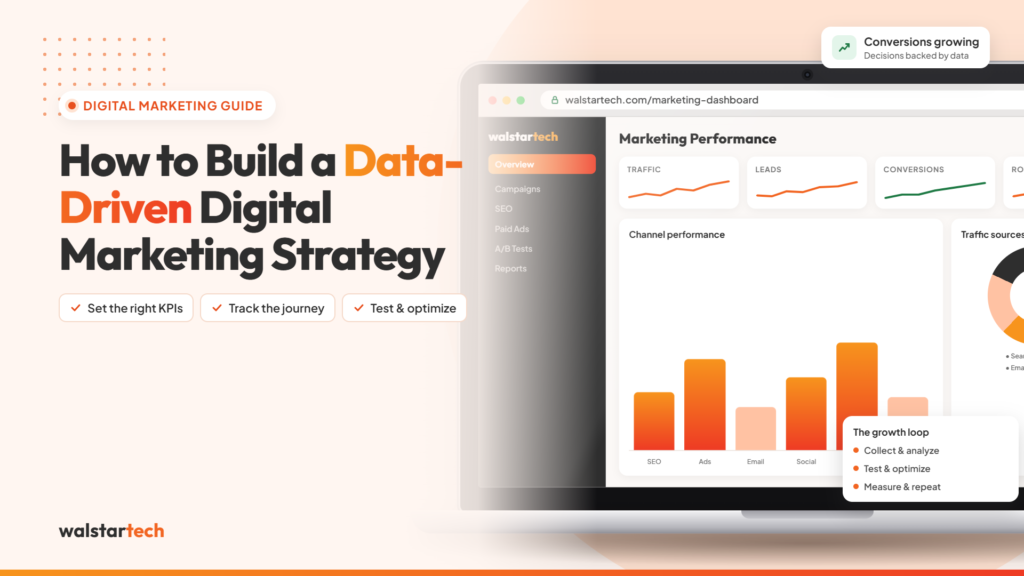
Collect → Analyze → Test → Optimize → Measure → Repeat
Review performance regularly and identify opportunities for improvement.
As customer behavior, search trends, competition, and advertising platforms change, your marketing strategy should evolve with them.
Common Mistakes to Avoid
Businesses often collect large amounts of data but fail to turn it into actionable insights.
Common mistakes include:
- Tracking too many irrelevant metrics
- Ignoring conversion data
- Making decisions based on assumptions
- Focusing only on website traffic
- Failing to test campaigns
- Not connecting marketing data with sales data
- Ignoring mobile users
- Failing to review campaign performance regularly
The most valuable data is data that helps answer specific business questions.
How Data-Driven Marketing Supports Business Growth
A data-driven approach allows businesses to make marketing decisions with greater confidence.
Instead of asking, “Which marketing campaign looks successful?” businesses can ask:
Which campaign generates qualified customers?
Instead of asking, “How much website traffic do we receive?” businesses can ask:
Which traffic sources generate conversions?
This shift from activity-based marketing to outcome-based marketing helps businesses focus resources on strategies that contribute to measurable growth.
Final Thoughts
Building a data-driven digital marketing strategy requires more than installing analytics tools. Businesses need clear objectives, reliable data, meaningful KPIs, continuous testing, and a process for turning insights into action.
From SEO and paid advertising to website optimization and customer journey analysis, data can help businesses understand what is working and where improvements are needed.
When marketing decisions are supported by reliable data, businesses can reduce wasted resources, improve customer experiences, generate better leads, and build a stronger foundation for long-term digital growth.
Frequently Asked Questions (FAQs)
1. What is a data-driven digital marketing strategy?
A data-driven digital marketing strategy uses customer, website, SEO, advertising, and conversion data to make informed marketing decisions.
2. Why is data important in digital marketing?
Data helps businesses understand customer behavior, measure campaign performance, identify opportunities, reduce wasted spending, and improve marketing ROI.
3. What data should businesses track for digital marketing?
Businesses should track website traffic, conversions, keyword rankings, advertising performance, customer behavior, lead sources, engagement, and acquisition costs.
4. How can data improve digital marketing results?
Data helps marketers identify high-performing channels, optimize campaigns, improve website conversions, refine targeting, and create more relevant content.
5. How often should a digital marketing strategy be analyzed?
Marketing performance should be monitored regularly, with detailed reviews conducted monthly or according to campaign goals, budgets, and business requirements.
Ready to Build a Smarter Digital Marketing Strategy?
Turn your marketing data into actionable growth opportunities with a strategy focused on measurable results, better targeting, and continuous optimization.
Start Your Digital Growth Journey Today.